Monday, 28 November 2011

Preliminary Task

In the preliminary task, we are required to make a film consisting of a person entering a room with another person in it. Then the two people will make conversation, and one of them will leave.

The short clip must contain the following elements: match on action, eyeline match, shot/reverse shot, and must also adhere to the 180 degree rue.

Match On Action
This is when we see an action continued from one shot to another, to give a sense of continuity, e.g. you could have someone opening a door in one shot, then edit it so the next shot displays the person entering the room.

Eyeline match
This is when the camera is looking at a person who is looking at something else, then the camera goes to what the person is looking at.

Shot/Reverse shot
This is employed when two or more people are having a conversation: the camera will focus on the person who is currently speaking at the time, and will alternate between the conversationalists. 

The 180 degree rule
A common mistake that is made when filming is to film movement from one side, then immediately film it from the other side. This mistake makes it seem to the audience that the moving thing or person has changed direction, when in actual fact they haven't.

The idea we have come up with consists of an audition for a wannabe magician. He performs a trick, messes it up, then in a fit of rage, accidentally performs it correctly without knowing, as he is storming off in anger.

Thursday, 17 November 2011

Paranormal Activity (2009)

  After recently moving in together in a home in the suburbs, a couple is terrorised by a demon, whose presence becomes more and more prominent.

  The director and writer of the film is Oren Peli. It's stars are Katie Featherstone and Micah Sloat. The film had a budget of $15,000 but still managed to pull in $77,873 on it's opening weekend (despite the fact it was only on 12 screens in the USA at the time). It's total gross was $193,355,800.
  The main problem faced by the film came about due to it's supernatural theme. It needed to make the supernatural seem believable to the audience.
  This was done through several ways. First, the audience were given a skeptic to identify with (Micah). As the film goes on, and the skeptic loses doubt, we are inclined to lose our doubt as well. Another technique used was the bringing in of 'experts', in this case it was Dr Frederichs and Dr Abraham (although we never see the latter). Another alternative for an 'expert' is the internet, which was also used in trying to uncover more information.
  Suspense is achieved with things such as the use of a handheld camera: it is not shot professionally so in a way we feel more into the story. Because we also watch over them sleeping, we see them to be vulnerable. The bed which they are on is white, however the rest of the room is also surrounded by darkness, which signifies the demon's presence, which surrounds them. There is also a lack of non diegetic sound, however this helps makes simple noises become scarier. There is also an effective use of volume - the audience jump when there is a sudden increase in volume.

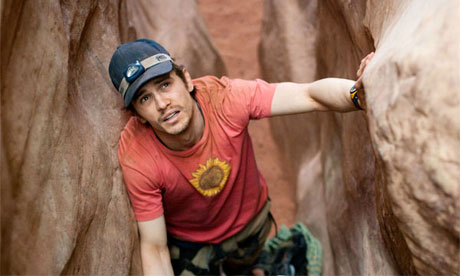
127 hours (2010)

  A thrill seeking mountain climber ends up trapped underneath a boulder whilst canyoneering on his own near Moab, Utah, and has to resort to extreme measures in order to survive the ordeal (based on a true story).
  The Director of the film was Danny Boyle.
  The film is not a conventional thriller - it's tension is built up in a different, but still effective way.
  The threat, or 'villain' was not from a human, but rather from nature - the hero is faced against natural dangers such as thirst and dehydration.
  However it retains the characteristics of a thriller with it's resourceful hero.
  The audience are encouraged to empathise with the hero through the establishment of normality at the beginning of the film.
  There was an effective use of both music (such as when his arm first becomes trapped) and silence (used throughout the film to signify the length of time he spends in the canyon).
  The camera would often be seen focusing on small details such as an ant crawling on the protagonist's face, his watch, and even sweat. There are also 'little dramas' which create tension in the viewer, such as when he drops the knife, or when he is forced to drink his own urine.
  The audience would be kept on edge through the mixture of optimism and pessimism, i.e. he succeeds in tasks such as obtaining the knife after he'd dropped it, creating a harness to help hold himself up while asleep (initially created to try and lever himself out). However when the knife proves useless at chiselling away the part of rock holding him down the audience is faced with despair. Mixed feelings also arrive when the audience is presented with past events in the protagonist's life, such as his childhood and his previous lover, and there are even premonitions to give hope of what could come if he survives the ordeal.
  There is also an effective use of close up - particularly when he comes to realise that he must sever his arm. 
  The trailer particularly misleads the audience - it is not explicitly advertised that majority of the film would be spent filming the protagonist trapped under a rock.


The Manchurian Candidate (2004)

  The Manchurian Candidate (2004) is a remake of the film of the same name in 1962, which was the film version of a novel of the same name made in 1959. The novel was a political thriller about the stepson of a political family, who has been unknowingly brainwashed, and thus is controlled into performing assassinations to benefit the Communist Party.
  The 2004 film was Directed by Jonathan Demme. It's stars were Denzel Washington, Liev Schreiber, Meryl Streep and Kimberly Elise. The film plot is similar to the plot of it's origin, but with some minor differences to account for more modern times - troops were brainwashed in the Gulf War (a more recent event). The threat presented was the power of big, global companies and the danger to the system of democracy we have (we, as an audience, would relate to this better than if the threat were from Communism).The film's plot also plays on the mind of the audience, as it can be asked, "How far can this concept of brainwashing be extended to reality?".
  The film's resourceful hero is Major Ben Marco, who is trying to find the truth and regain his sanity. The film presents him as hardy and masculine, and having the respect of many other men. He is used to danger and his history in the army presents him to be brave.
  There are a few scenes in the film which particularly stick out in the viewers' memories. The death of Senator Jordan was one. It differs from the older film in that more symbolism is used. In the old version of the film, the Senator is simply shot. In the newer version, he is drowned in a lake. There was a fog around at the time, which could be said to exaggerate the dream like state in which Raymond (the brainwashed 'assassin') was in at the time. The director had also said that he wanted this scene to symbolize the fact that the main characters were 'drowning' in a way.

  Another key scene was where Marco shoots Raymond and Eleanor. The film reaches it's climax when Raymond finally realises that his mind has been altered beyond recovery, and so decides to sacrifice himself rather than be used as a 'puppet'.
  There is also an undercurrent of the Greek myth of Oedipus - Eleanor was depicted to have an attraction towards Raymond. The film opted to display this with just a kiss to appeal to the censors (in the book, she uses her son's brainwashing to have sex with him).
  My personal preference would be the second, more modern film. It appealed to me more due to the fact it contained more recent things, and therefore things were easier to understand.